March in Bangkok Is Not a Travel Month and the Air Quality Is Why
The worst air in the world is a four-week window every spring, and it is predictable, it is regional, and one city is genuinely fine while another is not.
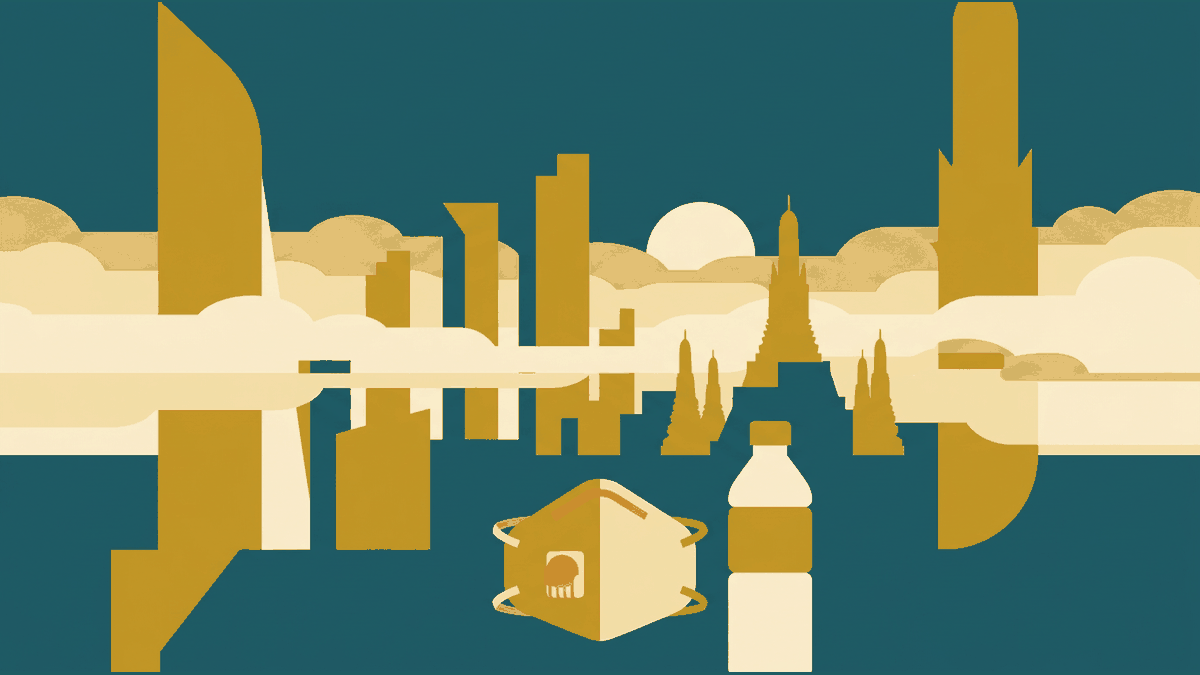
There is a two-week window every March when the air in Bangkok is worse than it is in any of the world's most polluted cities, and the cause is a combination of the weather, the burning of crops in neighbouring countries, and the fact that the air stops moving.
I have been in Bangkok in that window. It is not a dramatic orange sky. It is a flat grey ceiling about a kilometre up, the sun visible as a pale coin, and the specific feeling of having arrived somewhere and immediately needing to wash your face.
Last verified 31 August 2026.
When it is actually bad
February to April is the dangerous window, and late March into early April is the worst of it. The mechanism is straightforward. The cool season keeps a layer of polluted air close to the ground, the rains have not started, and the wind is frequently too weak to move anything.
Late March is also Songkran, which is a genuine clash: the water festival people plan a trip around happens when the air is at its annual worst. It is worth knowing before booking.
Northern Thailand in March is often the worst affected region in the country, not Bangkok, and the reason is crop burning on a scale that has become an international diplomatic issue with neighbouring countries. Northern cities in February and March can be genuinely hazardous rather than merely unpleasant, and the crop-burning problem is not a Thai-only phenomenon.
And the Gulf coast and the south are often considerably better in the same period, which is the single most useful fact in this article if you have a fixed date and a flexible destination.
What "hazardous" means in practice
The relevant measure is fine particulate matter, PM2.5, which is the fraction small enough to get deep into the lungs and is the thing health guidance is written about. Coarse dust and visible smoke are a poor proxy for it.
Check a current reading for the specific city on the day you arrive rather than trusting a seasonal article, including this one. Readings are available from national air quality monitoring networks and from a number of international monitoring projects, and the variation week to week is large.
For most healthy adults a few elevated days is a nuisance rather than a danger. It is genuinely unpleasant, it is measurable in how you feel in the evening, and it matters much more for children, for people with asthma or COPD, for pregnant people, and for anyone with existing heart or lung conditions. For those groups, treat a high reading as a reason to change plans rather than to buy a mask.
What actually helps, ranked honestly
1. Change the city. Nothing comes close. Moving from the northern plains to the southern coast for the same week solves it. This is the actual advice and everything below is a mitigation, not a solution.
2. Change the timing. November to January is genuinely good. October and the second half of April are usually fine. There is a real travel calendar here and it is not a secret.
3. An N95 or equivalent respirator, worn properly, which means over the nose and sealed to the face, not looped round the ears and hanging under the chin. This works. A loose surgical mask does not filter fine particulates to any meaningful degree, whatever it costs.
4. Doing the outdoor things at the right time of day. Particulate levels are usually lower in the afternoon than at dawn and in the morning, and the difference is not dramatic but it is real.
5. Being sensible about exercise. A run in peak conditions is the worst possible decision, and the people most likely to be running are the people most likely to notice the effect.
And what does not help, which is most of the internet: a branded mask with a decorative pattern, air purifiers that are too small for the room, salt scrubs, detox teas, activated charcoal supplements, and the idea that you can acclimatise to it in a week.
What nobody tells you about the burning season
The haze is not only from burning within Thailand. Transboundary smoke from agricultural burning in the region is a significant and well-documented contributor, which is why the northern air quality problem is partly a diplomatic one and not something an individual visitor can wait out.
Inside Thailand, the burn is crop residue after the rice harvest, and the practice has been illegal for years while remaining deeply entrenched, and it is a genuine and unresolved problem rather than a solved one with a lazy visitor.
Which means the annual pattern will probably still be here in the years you visit, and planning around it is more useful than being angry about it, though both are reasonable.
The honest summary
Thailand is not a bad country to visit in March. It is a bad month in a specific region, and a good month in another one. The Gulf coast in March is often warm, clear and excellent. The northern plains in March are not.
So the decision is simple if you are flexible and impossible if you are not. If your dates are fixed, check the reading for where you are actually going, carry a proper mask, and plan on spending more time indoors and less time on a scooter, because the two problems compound and the scooter is already the larger one.



