Thai Fruit Has a Calendar and Showing Up in the Wrong Month Is a Waste
Mangoes do not have a season, they have four, and they run north to south. A month-by-month guide and the dish that is genuinely worth the trip.
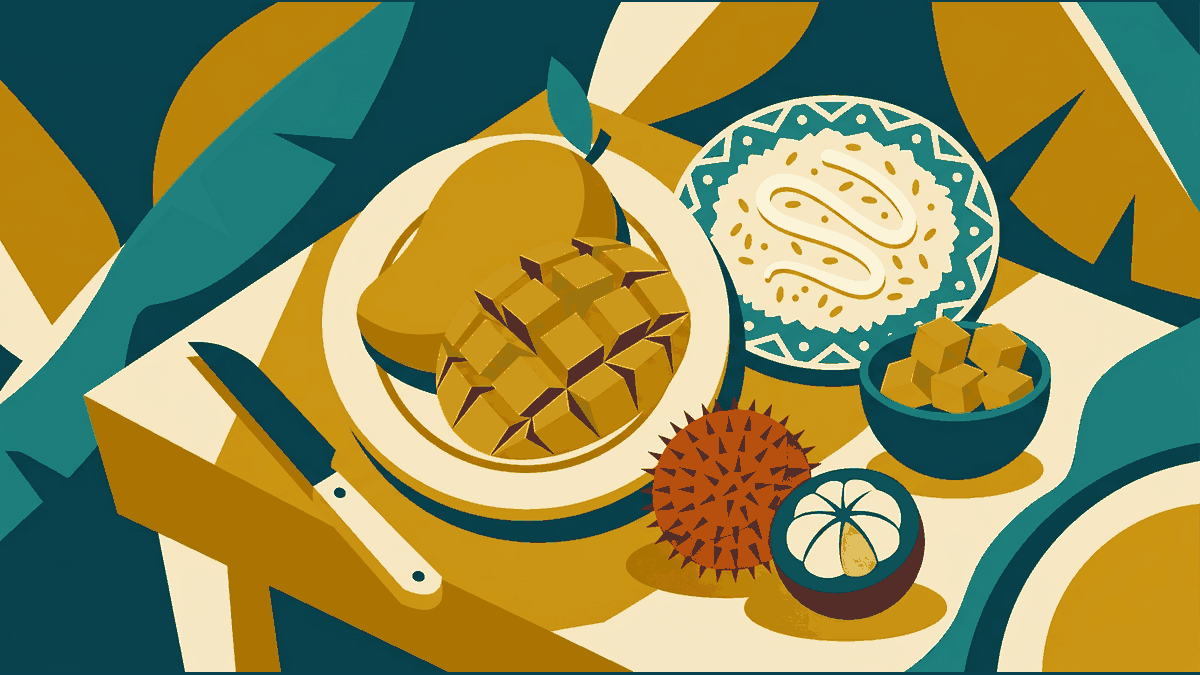
I arrived in Thailand in November and asked a fruit seller when the mangoes were good, and she looked at me the way you would look at somebody who has asked when it snows in June.
The mistake was not asking the wrong question. The mistake was that I did not know mangoes in Thailand are not a season, they are a calendar, and the calendar runs across the country from north to south, following the monsoon, and the same fruit is three months apart in Chiang Mai and Phuket.
Last verified 1 September 2026.
Why the fruit moves south
Thailand runs about sixteen hundred kilometres north to south and the flowering is triggered by the monsoon arriving in the region. The northern fruit flowers early, because the cool season ends earlier up there. The southern fruit flowers late, because the rains arrive late. Fruit therefore comes down the country like a wave.
So the same fruit is in season for a month in the north and a month in the south, three months apart. This is the single fact that makes Thai fruit planning possible, and almost nobody outside the country knows it.
The month-by-month version
January to March: the southern fruit. The Gulf coast and the deep south are in their season, which is why this is mango and durian season in Phuket, Krabi and the far south. The southern varieties are the earliest and are generally the sweeter, smaller, more aromatic ones. If you want fruit in January, you are in the south.
April to June: the central and northern fruit. Nam Dok Mai, the elongated yellow mango that is the definitive Thai mango, peaks broadly across the central plain and the north through this window. This is the famous window, and it is the one the whole country is waiting for.
June to August: the mountain fruit. Rambutan, longan, mangosteen and the mountain strawberries come from the cooler highlands, and this is when the north is worth eating at rather than merely visiting. July in Chiang Mai is the best fruit month in Thailand and almost no visitors are there for it.
September to December: pomelo, and the lean months. Pomelo peaks in the central region through the autumn. After that there is a genuine gap, and fruit becomes expensive and imported, and everybody is eating oranges. This is not a bad time, it is simply not a fruit trip.
The dish that is worth all of it
Khao niao mamuang, mango sticky rice, is a dessert with four components and it is ruined by getting any of them slightly wrong. Sticky rice steamed with coconut milk and a little salt. Mango, ripe but firm, sliced thick. A sauce of coconut cream thickened with toasted rice flour. And the timing, which is the whole thing.
The rice is eaten slightly warm and the mango is eaten cold, and they are eaten together. This is not a plated dessert you approach with a fork. You are expected to take a mouthful of each.
Get it from a stall that has a queue, at a point in the day when the mangoes are being cut to order rather than sitting in a tray. The version that has been sitting out for an hour is a different dish and much of the time the mango has been treated to look ripe rather than to be ripe.
And check the mango before you buy. The best ones smell like honey at the stem end and give very slightly at the shoulder. A mango that is already soft at the tip is going to be mush, and there is no way to fix that in a bowl of sticky rice.
The other four worth knowing
Durian, which has a season too, roughly May to August, and which is a genuinely divisive experience that no amount of description will prepare you for. It is also illegal to carry it on public transport and into most hotels, which is a real logistics problem and also the reason the smell does not follow you around.
Rambutan, a red hairy fruit that is a peeled, eaten-in-one-go affair, available in season roughly May onward, and much better than it looks.
Mangosteen, in season around May to September, and the correct way to eat it is to squeeze the whole fruit until the calyx opens, twist, and eat the segments inside. The white segments are the point; the purple rind is a mess and in some countries a stain.
Longan, which is a tree fruit harvested in the north and is the thing you eat by the handful while walking through a market in Chiang Mai in July.
How to buy it, briefly
Street stalls are the right place and whole fruit is the right price. Cut fruit in a plastic box from a market stall has usually been sitting, which takes it back to the food-safety point in our street food post: buy it whole, and peel it yourself.
Buy the amount you will eat in one sitting. Thai fruit is picked ripe and does not travel. A kilo of perfect mangoes is a kilo that will be a kilo of very soft mangoes by tomorrow morning, and this is the single most common way visitors waste money on fruit.
And eat the season, not the list. If you are there in December, you are eating pomelo, and you should be happy about it, because the pomelo is genuinely excellent and it is the fruit nobody comes to Thailand for.



