You Walked Past Nine Shrines This Morning and Did Not Know What They Were
The little house on a post outside every Thai home and shop is not a temple. What it is, what goes on it, why red Fanta matters, and the seven things never to do.
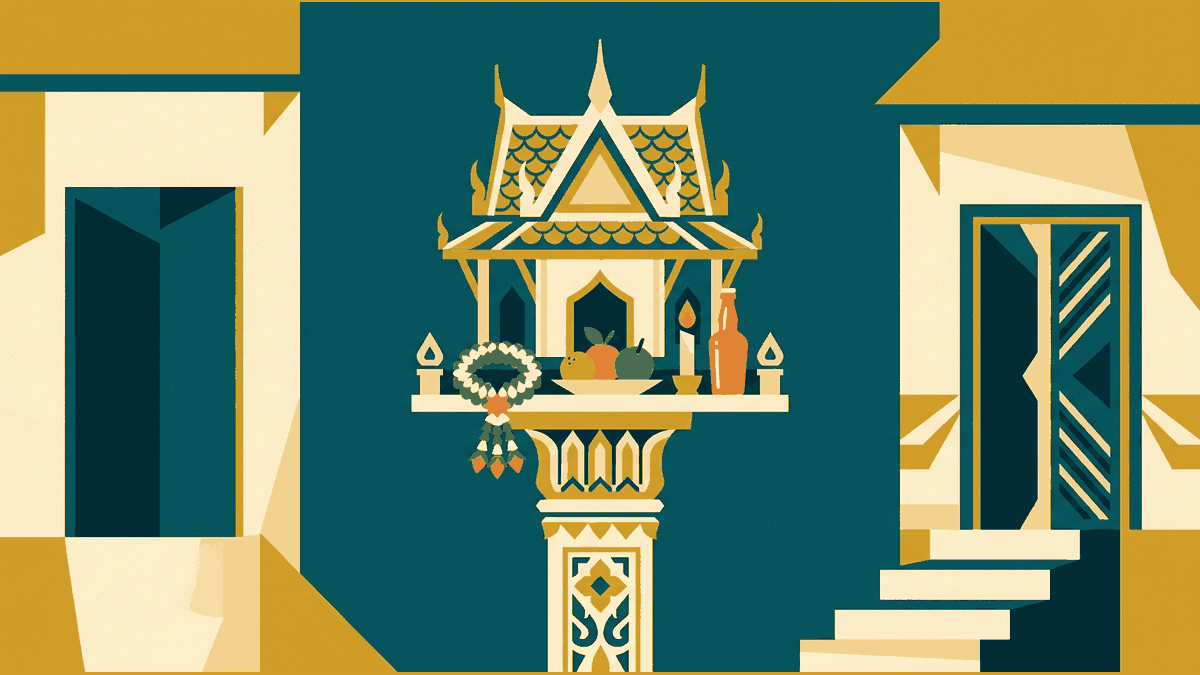
There was one at the corner of my soi, another outside the laundry, a third on the reception desk of the guesthouse, one on the shop counter where I bought water, and three more along the four hundred metres between the market and my front door.
Every one of them was a small house, about a metre tall, on a post, with an open front, a garland, and something on the shelf inside.
I had no idea what any of them were.
Last verified 6 October 2026.
It is not a temple and it is not a shrine to a Buddha
A san phra phum (ศาลท้าวมหาพ่อ, or ศาลปู่) is a dwelling built for the guardian of a place. The belief underneath it is older than Thai Buddhism and not the same as it: an animist and Brahmanic layer in which every piece of land has a tenant, and the tenant will either be housed properly or it will make itself a problem.
So it is not worship. Nobody prays at a spirit house the way a person prays in a wat. It is tenancy. You give the guardian a house, you feed it, you keep it in the auspicious corner, and it looks after the property. In practice they sit comfortably beside Buddhism rather than in tension with it, and most families do both without finding it odd.
Inside, the small figure is the guardian itself: usually depicted holding a sword in the right hand and a money pouch in the left, or as phra phum chao thii, the master of the land. This is also why a house being built often starts with a ceremony to invite the old tenant to move, because the land is not empty and you are not the first tenant.
Where it goes, and why the position is not arbitrary
Placement is done properly, usually by a rodet, a Brahmin or an auspicious elder, on a date picked for the property. The rules people repeat are:
The shadow of the main building must never fall on the shrine, and the shrine's shadow must never fall on the house. That single rule pushes it away from the structure, usually into a corner.
It is commonly set in the southeast of the plot, facing east or north — the auspicious directions.
It is not placed to the left of the front door, and it does not face the road, the toilet, or the house's own entrance, all of which count as disrespect or insult.
It keeps at least a metre from a wall or a fence.
You do not need to check any of this. It is somebody else's arrangement and it was done by a professional. The only reason it is here is that it explains the thing you have been staring at.
What people put on it
Offerings are simple and they are daily. Jasmine garlands, marigolds, banana and betel leaves, rice, boiled eggs, cooked chicken or duck, a bottle of water, incense and a candle.
And a red bottle. Red Fanta or a red soft drink with a straw in it, because red is considered lucky and the spirits are supposed to like it. You will see the straw sticking out, already bent, and the bottle is usually replaced rather than drunk.
Food is typically left for about a week before being replaced, which is unsettling if you have ever eaten in Thailand and is worth knowing before you explain the smell on the third day to anyone.
On the base of the post you will often see a smudge of red or pink. That is rad si (ราดสี), a red fabric marker used to designate a person or a house that has been taken by a spirit. It is not graffiti and it is not removed.
Turning days. The two most common shrines are phra phum for a male guardian, traditionally offered on Monday and Wednesday, and phra nang for a female guardian on Tuesday and Friday. Saturday and Sunday are the general days. It explains why you will see a rush of food on the street just after a Tuesday morning.
The seven things never to do
This is the section worth pinning to a wall, because the list is short and the penalties are real, socially rather than legally.
Never point your feet at it. The feet are the impolite part of the body and aiming them at anything sacred is a genuine insult. If you sit on a low wall near a shrine, do not swing your legs toward it.
Never touch the offerings, the figurines or the structure. Not to straighten it, not to tidy it, not to move a dish. It is not yours and it is not a mess.
Never step on the platform or climb the base. Children get stopped. Adults get stopped harder.
Never use it as furniture or a backdrop. Do not sit on the ledge, do not park a scooter against the post, do not stage a photo where you are holding a drink and grinning at the camera. This is the single most common failure, and it is the one locals notice.
Never point at it with a finger when describing it to someone. Use an open hand, or describe it with a nod.
Never block it. If it sits in a driveway island, you walk around the offering zone, not through it. This one has broken shops.
Never ask the staff to pose while they are doing their morning round. Wait. Or, better, do not ask.
If you actually want to make an offering
It is a kind thing to do and it costs almost nothing. A garland, a piece of fruit, a bottle of water, or a red Fanta. Put it gently on the shelf, and step beside the platform rather than on it. Do not rearrange anything you have added to something else already there.
That is the whole ritual as far as a visitor is concerned. You are not converting, you are not committing to anything, and nobody will be surprised.
Photographing them
Plain photographs of the shrine itself are usually fine, in public, without ceremony. What is not fine is a person in the middle of a prayer. If somebody is making an offering, put the camera down and wait. It costs you four minutes and it is the difference between a visitor and an idiot.
You will also notice these shrines on the backs of trucks, on shop counters, on a bridge abutment, on a tree wrapped in coloured cloth, and in the middle of an empty car park. That last one is the oldest form — before there were houses, a big tree or a boulder was the shrine, and the cloth is the ancestor of the altar.



