Thailand Checked Baggage Rules: Security Can Open Your Bag Today
Security can open a flagged checked bag without you present from 16 October 2026. What triggers it, what a TSA lock saves you, and what never comes back.
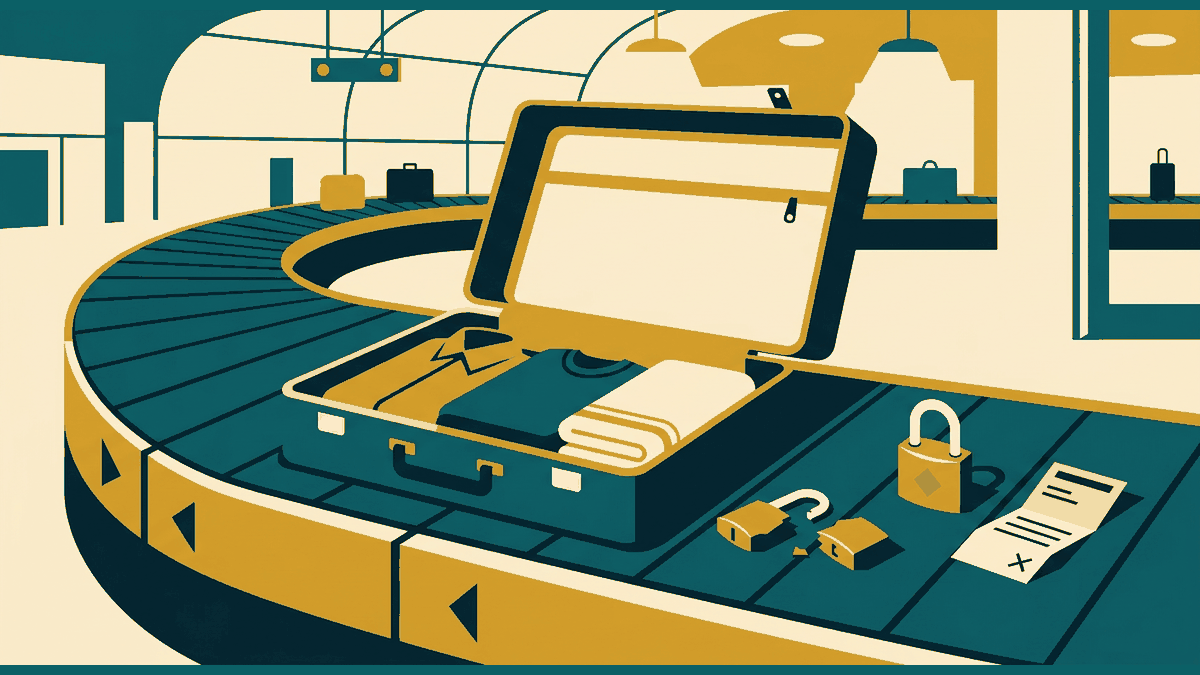
The rules changed on 16 October 2026. Airport security can now open a checked bag without waiting for you, provided screening gives them reasonable grounds to suspect a prohibited or dangerous item. The bag goes to a designated area, the inspection is video recorded, and a notice goes inside so you know it happened.
Last verified 16 October 2026 against the CAAT regulation and its 11 October clarification. This is the first day the rule is in force.
I checked both the Thai announcement and the English coverage, and the framing split immediately. The Thai reporting is about baggage delaying flights. The English reporting is about whether you get compensated when nothing illegal is found. Both are the same rule, and the second question is the one that affects your money.
What the new Thailand checked baggage rules say
The Civil Aviation Authority of Thailand issued the regulation on 24 February 2026 under the title Inspection of Registered Baggage Carried on Aircraft, B.E. 2569. It took effect on 16 October.
The change is narrow and worth stating precisely. Security officers could already open a flagged bag. What they could not do was open it without you standing there, which meant paging you through the terminal while a flight waited. The new rule removes that step. Public airport operators now have the authority and the duty to inspect registered baggage, and a bag flagged at screening can be opened in your absence.
Two things have not changed. The trigger is still a screening hit, not a rota. And the prohibited list is the same list it always was. What changed is what happens after something on that list shows up on a screen.
| Point | Before 16 October 2026 | From 16 October 2026 |
|---|---|---|
| Opening a flagged checked bag | Office could open it only with the passenger present | Office can open it without the passenger present |
| Grounds required | Screening hit | Screening hit, restated as reasonable grounds |
| Location | Airport discretion | Designated inspection area |
| Evidence | No recording duty | Images recorded and retained |
| Notification | In person, at the belt | Printed notice left in your luggage |
| TSA-approved lock | Unlocked, master tool | Unlocked, master tool |
| Any other lock | Cut or forced | Cut or forced, no compensation |
| Seized items | Not returned | Not returned, further action under relevant laws |
| Scope | Flights departing Thailand | Flights departing Thailand, all airports |
The trigger and the prohibited list are both unchanged. The instruction to screen for reasonable grounds rather than on a rota was repeated in public, which is what stops this reading as a licence to open anything at will.
Can Thai airport security open my bag without me?
Yes, but only on reasonable grounds. A bag can be opened when screening suggests it holds an explosive, dangerous goods, a prohibited article, or anything else barred from an aircraft. The authority has been explicit that this is not authority for random searches, and it repeated that limit in a clarification issued on 11 October, five days before the rule went live.
The procedural requirements are the part that protects you. The inspection happens in a designated area rather than at the belt. Images and evidence are recorded, and the record is kept so an authority can later establish who opened the bag and what they found. You are told afterwards rather than during.
That record matters more than it sounds. It is the mechanism you use if something goes missing. Ask the airport operator to review the procedure and the footage, and do it before you leave the terminal, because a claim is straightforward at the airport and awkward three countries later.
What happens if your bag gets flagged
Your bag is taken to the inspection area and opened on camera. The officer opens a TSA-approved lock using the master tool and closes it again. Any other lock is cut or forced.
Anything prohibited inside is seized. Seized items are not returned, and further action follows the relevant laws where warranted. That last clause is doing real work. A power bank is a confiscation. Cannabis in a suitcase leaving Thailand is a criminal charge, handled under Thai law rather than as a security matter.
The paperwork is placed inside the bag, headed Notice of Baggage Inspection. This is the part I would brief anyone on before they fly, because finding an unexplained slip of paper under your clothes on arrival reads as theft or tampering. It is neither. It is the lawful record that your bag was opened, and its presence means the system worked the way it is supposed to.
Do I need a TSA lock for Thailand?
It is a recommendation rather than a requirement, and it is the single cheapest thing you can do. At inspection the lock is opened with the officer's master key and closed again, so it survives the process intact. A standard padlock on a flagged bag gets cut, and CAAT has confirmed there is no compensation for the damage even when the inspection finds nothing.
You can identify a TSA-approved lock by the marks on it. A small red diamond is the Travel Sentry standard. A red torch is Safe Skies. Most carry a code such as TSA007 beside a small keyhole, which is the master-key slot. No mark means assume it is not TSA-approved and expect it to be cut if your bag is ever opened.
The weakness in the whole arrangement is that a TSA lock is a tamper indicator rather than a security device. Anyone holding the master tool can open it. It keeps your bag intact and tells you that it was opened, and it does not stop anybody. Cheap combination locks are the other common failure, bought for the colour when the colour is not the thing being inspected.
What should never go in a checked bag in Thailand
Start with the items that are prohibited outright. Power banks and spare lithium batteries go in the cabin, without exception. Vapes and lighters go in the cabin or on your person. Anything on the airline's dangerous goods list stays out of the hold.
Then apply CAAT's own advice, which goes further than the prohibited list. Do not check valuables, fragile items, important documents, or essential medication. The reasoning is not about inspection at all. It is that a checked bag can be opened by security, delayed by weather, or sent to a different city, and none of those outcomes are recoverable if your passport or your daily medication is inside it.
The category people get caught by is the everyday one. A laptop you did not want to carry. A spare camera battery. A bottle of something from a market that turns out to be over the limit for the hold. The 100ml rule applies to your cabin bag, where liquids are capped at 100ml per container in one clear litre bag. Checked baggage has no such limit, which is exactly why people move things into it without thinking.
Is this worth worrying about?
For most travellers, no. This is a rule about a bag that has already alarmed a scanner. If your bag screens clean, nothing about your trip changes, and on a normal flight the overwhelming majority of bags screen clean.
The trade-off is a real one and I would rather state it than smooth it over. The rule asks you to accept a lock being cut with no compensation, on a bag that turns out to contain nothing wrong. The Thai reporting treats that as the price of not holding flights, and the English reporting treats it as the flaw. Both descriptions are accurate. The fix costs about the price of a coffee, which is why the argument has not gone further.
There is a wider tightening behind this one. Biometrics are planned at bag drop, and crew face the same screening as passengers. Treat the direction of travel as set rather than as a one-off rule.
One caveat worth naming, because the rule reads stronger than it behaves. None of this covers your cabin bag, so the hand-luggage limits you already know are unchanged. And the protection depends on the airport following its own procedure. The recorded images are only useful if you ask for them while you are still standing in the terminal, which is a drawback of a system built around telling you afterwards rather than during.
Frequently asked questions
Can airport security in Thailand open my checked bag without me?
Yes, since 16 October 2026. Officers can open a checked bag without the passenger present when screening gives reasonable grounds to suspect a prohibited, dangerous, or restricted item. The inspection happens in a designated area, is video recorded, and finishes with a Notice of Baggage Inspection tucked in among your things.
Does the new rule apply outside Bangkok?
It applies nationwide. This is a CAAT regulation covering every Thai airport rather than a Suvarnabhumi measure, so Phuket, Chiang Mai, Hat Yai and Don Mueang work the same way. Flying home from Phuket, the procedure matches Bangkok exactly.
Will my bag be opened at random?
Random opening is not what this permits. Inspection requires reasonable grounds arising from a screening hit, a limit CAAT restated in its 11 October clarification. The rule exists so a flagged bag stops holding a flight while staff page its owner.
Do I get compensated if my lock is cut and nothing is found?
There is no compensation provision. CAAT's guidance has a TSA lock opened undamaged, while any other lock can be cut or forced, and nothing in the regulation covers the damage. The Pattaya Mail raised this point when the rule was announced: the passenger carries the cost of the false alarm.
What if something is missing from my bag after an inspection?
Ask the airport operator to review the procedure and the retained images. CAAT requires inspections to be recorded and evidence kept precisely so that an inspection can be traced afterwards. Report this before leaving the terminal rather than after, because the record is easiest to reach while you are still standing in the building.
The two-minute version
Fit a TSA lock. Keep batteries, medication, documents and anything you would grieve in your cabin bag. Finding a printed notice inside your luggage is not a problem. Read it, then check the contents.
That covers the whole rule. Everything else about the way you pack for Thailand stays exactly as it was.
The wider travel-money picture is unchanged this week, so what Thailand costs in 2026 still holds, and the arrival side of a Bangkok flight is worth reading before you land rather than after.
Sources for this post: the Civil Aviation Authority of Thailand regulation Inspection of Registered Baggage Carried on Aircraft B.E. 2569, issued 24 February 2026 and in force from 16 October 2026, as reported by the Nation Thailand and Khaosod English; CAAT's procedural clarification of 11 October 2026; and the Pattaya Mail's analysis of the no-compensation provision.