Bangkok Flooded in All 50 Districts and Six of Them Still Are
Three hundred millimetres of rain in two days, a disaster declared across all 50 districts, and not one flight cancelled. What a Bangkok flood does to a trip, and which six districts are still wet.
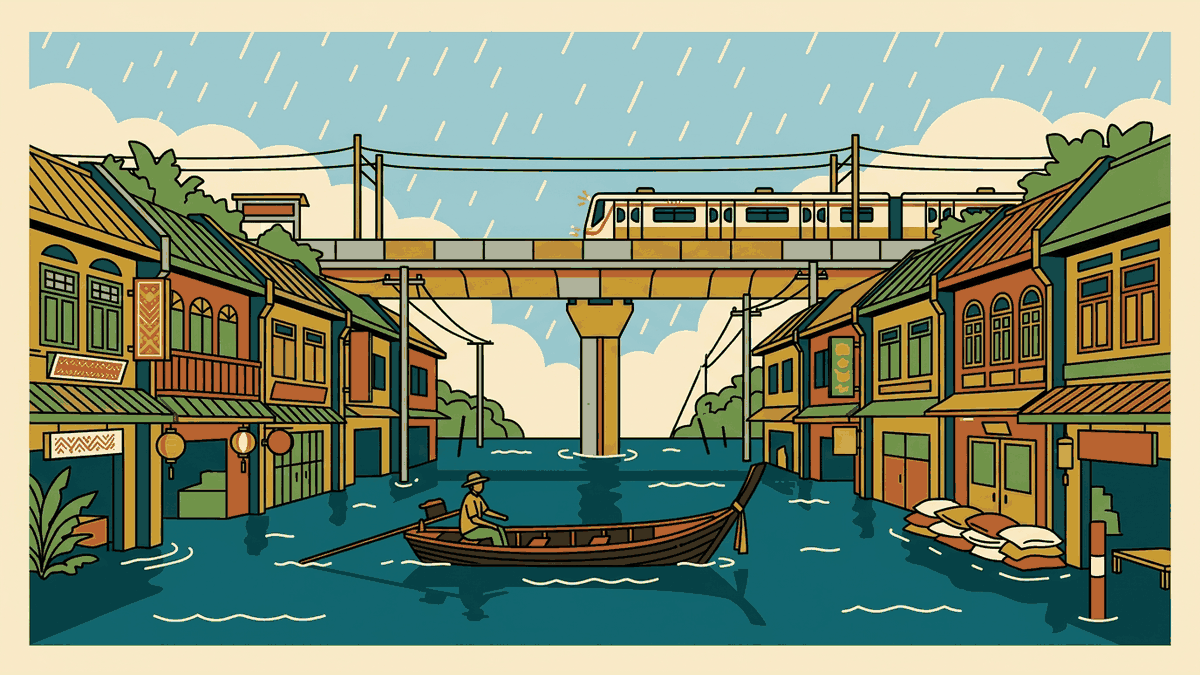
I have never seen sandbags in front of a 7-Eleven and a queue inside it at the same time. That was the last Saturday of September, on a soi off Ramkhamhaeng, and the water on the road was already over the kerb and moving in a direction I did not expect.
Here is the thing that took me days to understand, because nobody says it plainly: Bangkok flooded badly enough to be on the front page of the Guardian, and the city did not stop. The trains ran. The temples opened. The airport never closed, not for one hour. What the water took was the roads, and the roads are how every other part of the trip gets where it is going.
Last verified 13 October 2026. This story moves, so the status section below is dated and everything after it is what stays true from one flood to the next.
Where it stands on 13 October
In parts of the city, roughly 300 millimetres fell in about two days — around half of London's annual rainfall, in a city built on a river delta. The government declared a flood disaster across all 50 of Bangkok's districts.
Keep the human number in view, because it is the part that gets buried under the travel advice: 31 people had died in floods nationally since mid-September, four of them in Bangkok, and more than 3.5 million people were affected, according to the Department of Disaster Prevention and Mitigation. This is not a story about wet shoes.
By 10 October, after two rain-free days, the flooding in the city had eased significantly — but water was still standing in 97 communities across six eastern districts: Min Buri, Nong Chok, Prawet, Saphan Sung, Lat Krabang and Bueng Kum. Most of those sit along canals, where drainage is still limited by the sheer volume of water sitting around the capital. Coastal pumping facilities were running at roughly half capacity.
More rain was forecast. The Thai Meteorological Department's warning on 11 October covered heavy to very heavy rain through 13 October, with the South under it for the whole period and, on the 13th, the lower North, the lower Northeast, the Central region including Bangkok, the East and the South. Waves in the Andaman Sea and the Gulf were forecast to exceed two metres in thundershowers.
And the water arriving from elsewhere is the part nobody plans for: Vajiralongkorn Dam was at 98% of capacity and Srinagarind at 90% in the Mae Klong basin, which means releases upstream keep feeding a system that has already had enough.
The airports never closed. Getting to them was the problem
Both Suvarnabhumi and Don Mueang stayed open through all of it, aircraft took off and landed normally, and at Don Mueang — where water flowed onto part of the southern taxiway — operations continued.
The failure was entirely on the ground. Flooded roads, ground staff who could not reach the terminal, delayed baggage handling. Thai Airways reported broken baggage carts on top of the staff shortage, and passengers reported long waits at the carousel; hundreds of Korean passengers on a Thai Airways flight out of Suvarnabhumi waited more than 14 hours, with the departure pushed back four times, and said afterwards that nobody told them anything.
Two specific roads are the ones to know about:
To Suvarnabhumi, avoid the Lat Krabang route, on the airport's northern side, which had deep standing water. The airport's own advice is Motorway 7 or the Burapha Withi Expressway — or the Airport Rail Link, which is elevated and does not care what the road is doing.
To Don Mueang, the flooded stretches were Vibhavadi Rangsit Road and Chaeng Watthana Road, and for a stretch metered taxis were hard to find. The tollway and the SRT Red Line were the ways in that kept working.
Timing, from the airport's own advice: three hours before an international flight, two before a domestic one — and that is the check-in buffer. Travel time is on top, not instead. Check your flight directly with the airline, not with whatever a booking site last decided to tell you.
What actually floods, and what never does
The pattern is consistent enough to plan around, and it is not "Bangkok".
The east takes it worst — Lat Krabang, Min Buri, Nong Chok, Bueng Kum, Prawet, Saphan Sung, and the whole Suvarnabhumi corridor. The north takes it along Vibhavadi Rangsit and Chaeng Watthana. Everything low-lying and canal-side takes it, which has always been true and always will be.
What does not flood matters more: the elevated and underground rail kept running normally — MRT Blue, Purple, Yellow and Pink all operating, with stations opened to shelter people — and so did the BTS, the Airport Rail Link and the intercity rail network wherever track conditions allowed. Suvarnabhumi did not flood. The districts most visitors actually stay in — Silom, Sukhumvit, Rattanakosin, the riverside — were not the flooded ones.
This is also not 2011, when Don Mueang shut, water sat in the northern suburbs for weeks and a third of the country was affected. What Bangkok gets in a bad October is pocket flooding: streets, sois, underpasses and housing estates under water, sometimes for days, while the city three kilometres away is having lunch.
Why it fills up faster than it should
The city's drainage was built for roughly 60 to 70 millimetres of rain — the governor's own working figure. Above that, water sits.
The problem in October 2026 was that the canals and retention areas were already full when the next storm arrived, so rainfall the city could normally absorb started to pool. The Chao Phraya itself was never the emergency: it stayed more than a metre below the flood barriers through the worst of it. The water causing the trouble was the water that could not get to the river.
Flat city, sinking ground, high tides at the Gulf, upstream releases on a schedule decided somewhere else. None of that is fixed by a better holiday itinerary. All of it is why the same storm floods one street and not the next one.
The other thing happening in Bangkok this week
Bangkok is hosting the IMF and World Bank Group Annual Meetings from 12 to 18 October at the Queen Sirikit National Convention Center, with around 15,000 registered delegates from 191 countries and officials expecting something closer to 20,000 people in town.
You care about this for three reasons. Hotels around Rama IV, Asok and Phrom Phong are fuller and more expensive this week. There are road controls and security around the venue. And the government has prepared four water-management scenarios for the event itself — in the more serious ones, delegates are moved onto the Skytrain and the Metro, and officials have said evacuation plans are ready if levels rise.
For context on what "busy" means here: Bangkok's average hotel occupancy was 76.2% in the first half of 2026 and the average daily rate actually fell 2.1% to about 4,013 baht, so the city came into October with room. This week it does not have as much.
What it does to the rest of your trip
The rain moved south, which is where most people's second week is.
Heavy rain was forecast through 13 October across Chumphon, Surat Thani, Nakhon Si Thammarat, Phatthalung, Songkhla, Pattani, Narathiwat, Ranong, Phang Nga, Phuket, Krabi, Trang and Satun. With waves over two metres in thundershowers, small boats, ferries and snorkelling trips get cancelled — and the call is usually made on the morning, by the operator, based on the actual sea.
So the rule for October and November is simple: do not put a boat on the same day as a flight. Not a ferry to an island on the morning of a departure, not a snorkelling trip the afternoon before a long-haul. Two days of slack costs you nothing and saves you a rebooked ticket.
And if your plan is the Gulf — Samui, Phangan, Tao — remember that coast is entering its wet season now, the one that peaks in November, which is the opposite of what the Andaman is doing. The two coasts do not share a climate and never have.
If you are arriving this week, do these things
Do not wade. The water coming up through the drains is the same water that came out of everything on either side of the street, and open drains do not announce themselves. This is the advice that sounds fussy until you are the person who did it.
Do not ride a scooter through it. Stalled engines, invisible potholes, open grates, and traffic that does not slow down. Your rental insurance will not cover it, and this is the wrong week to test that.
Expect ride-hailing to be slower, dearer and more likely to say no, and expect the same from taxis, with the meter conversation getting harder the more water is on the road.
Everything elevated still works. BTS, MRT, Airport Rail Link, malls, hotels, airports. If your day can be built along the rail lines, it will run.
Carry water, cash and a power bank, put the phone in a plastic bag, and keep one dry pair of shoes in reserve. It is a small kit and it fixes most of what goes wrong.
If you have a free-cancellation booking in east Bangkok — Lat Krabang, Bang Kapi, Min Buri, Nong Chok — you have a cheap option to move to the centre or the riverside. Take it. This is the month that free cancellation is worth something.
The numbers, in one place. Bangkok flood hotline 1555. Tourist Police 1155. TAT contact centre 1672. Disaster prevention 1784. Medical emergency 1669. Police 191. Suvarnabhumi +66 2 132 1888. Don Mueang +66 2 535 1192.
The verdict
Do not cancel an October trip over this. That is the honest answer and it is not the comforting one, because October is the month this happens and everyone booking a cheap flight in July is quietly buying that risk.
What you should do costs nothing: build slack into the two days that involve a plane or a boat, keep your base out of the east, and stop scheduling a holiday to the hour. The city absorbs this every year, the water goes down, and the temples are still there.
The rain is not a reason to stay home. It is a reason to stop booking Thailand as if the weather were something you could put in a spreadsheet.
- The Worst Thing That Happens in Thailand Is Not the
- March in Bangkok Is Not a Travel Month and the Air Quality
- Bangkok Has Free Things That Are Better Than the Paid Ones



