How to Get a Taxi in Bangkok Without Being Ripped Off
Meter on or off is one sentence, and the whole thing takes eight seconds once you know it. The rest is knowing which vehicle to wave down.
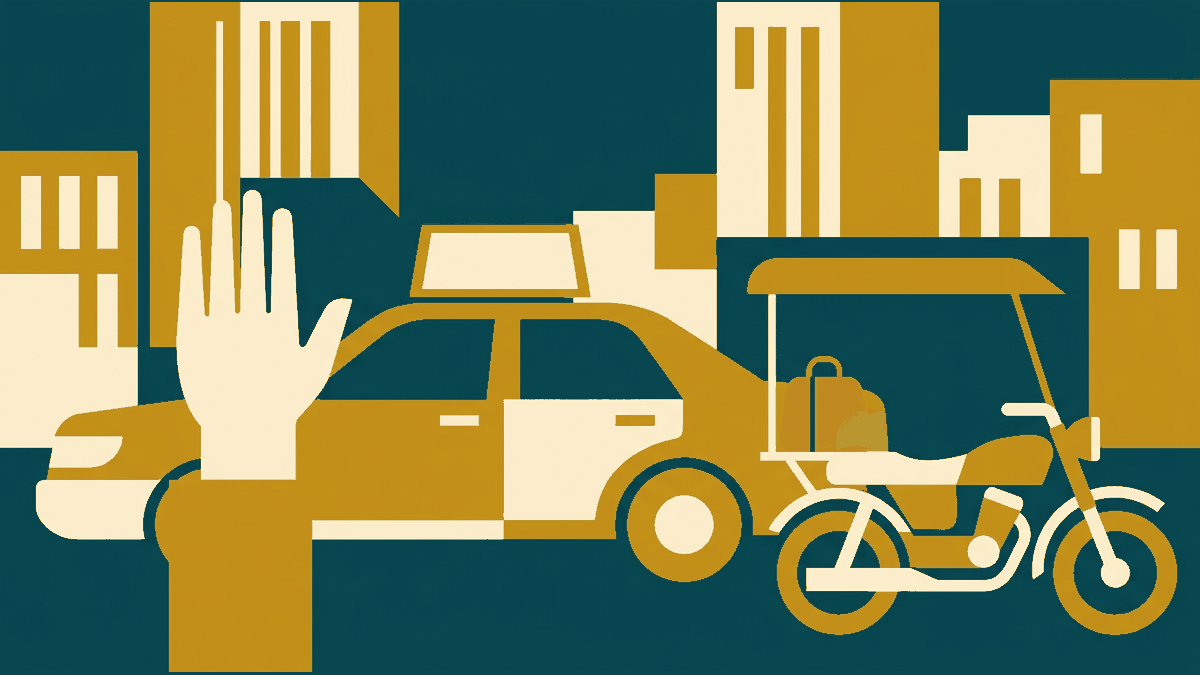
There is a phrase. It is four syllables, it works in every accent, and it is the difference between a two-hundred-baht ride across the city and a two-thousand-baht argument you will still be having at the hotel.
The phrase is meter on. In Thai, metere sai. Say it as you get in, before the door is even closed, and about ninety per cent of the problem this article describes disappears.
Last verified 6 September 2026.
What you are actually dealing with
Bangkok has four kinds of taxi and they are not interchangeable.
The pink taxi. Individual drivers, metered, the default. There are thousands. They are everywhere and they are almost always the right answer.
The orange and green taxi. Two-tone, also metered, slightly newer vehicles. Same deal.
The tuk-tuk. A three-wheeled motorbike with a roof. Not metered. Charged by negotiation, and the negotiation is the point. Used more as a sightseeing or short-hop vehicle now than as transport, because they are slower and less comfortable than a car for the same money.
The motorcycle taxi, which is the one nobody warns you about. The driver sits on the bike, the passenger sits behind them, and a large bag sits on the back. They are everywhere, they are cheap, and in Bangkok traffic they are frequently the fastest thing on the road by a factor of three.
How to hail a taxi
Do not flag one down. That is not how it works and you will be ignored. You stand on the kerb and you wait, and a taxi will come to you. They are looking for exactly what you are doing.
Signal the destination with a hand gesture, because that is what everybody does and it is a pointing finger in the direction of travel, repeated slowly. A raised open hand stops the car. A pointed finger means where.
Say the destination, out loud, before the journey starts, and there is a specific trap here: a driver who begins by saying "too far" or "road closed" is often telling the truth about a flooded road in the rainy season, and just as often auditioning for a much longer detour and a much higher fare. Mention the destination, and if they push back, wave and get in the next one.
The four things that cost money unnecessarily
1. Not saying metere sai immediately. If the driver does not turn the meter on within a few seconds, say it again. If the driver refuses, get out. This is the single most important habit in this article.
2. Tollways. If you ask for a route that uses an expressway, the toll is added to the meter, and it should be. Ask whether the route includes a toll before you set off, and agree the number in advance. It is normally small, but it is the source of the classic "the meter was correct but the toll was invented" argument.
3. The airport. The fare from Suvarnabhumi to central Bangkok is a flat rate, not a meter, and it is posted. The driver will quote it, and if they quote more than the posted rate you have a legitimate reason to decline. There is an official taxi service with a fixed counter, which has a queue and takes slightly longer and is worth it at midnight with luggage.
4. The last hundred baht. Round down. Do not pay the exact meter fare on a short trip, because a driver who has earned forty baht on a two-hour trip will remember that you paid the fare to the satang and will remember it for a year.
When a motorcycle taxi is the right answer
Short distances in heavy traffic. Three kilometres across central Bangkok can be forty minutes in a car and six minutes on a motorcycle.
You are alone with a small bag. This is the correct case. With a suitcase it is a different conversation entirely, and the driver will say no, which is fair.
You have somewhere to be and the traffic is bad. The risk is real and small: if you are in a genuine accident on a motorcycle taxi you have no insurance, no helmet in most cases, and a driver who may leave. The mitigation is obvious and cheap. Wear the spare helmet. Drivers have one on the back for a reason, and it is not decoration.
Learn the fare before you go. Motorbike taxis are typically a flat rate for short journeys, commonly quoted at 50 to 80 baht depending on distance, and it is agreed by gesture before you set off, not in an argument afterwards. Point at the destination, hold up fingers, and go if the answer is right.
Apps, and the real reason to use one
Grab is the practical answer to all of the above. Fixed price shown before you accept, driver name and plate visible, no negotiation, car type chosen, and a record of the journey.
It is the right choice for a first trip from the airport, at night, with luggage, or with children, and it is genuinely used by locals rather than being a tourist-only workaround.
It is worse for the thing taxis are actually good at, which is hailing one on a random side street in a hurry with no signal. The taxi is faster at that, and it always has been.
The three-baaht lesson
Remember that a metered Bangkok ride is one of the cheapest urban transports on earth, and that almost all of the horror stories come from the same mistake: getting in without saying the words.
Say metere sai, watch the meter start, agree tolls in advance, and round down. Four habits, ten seconds of effort, and you will have a completely uneventful ride in a city with more traffic than anywhere you have been.



